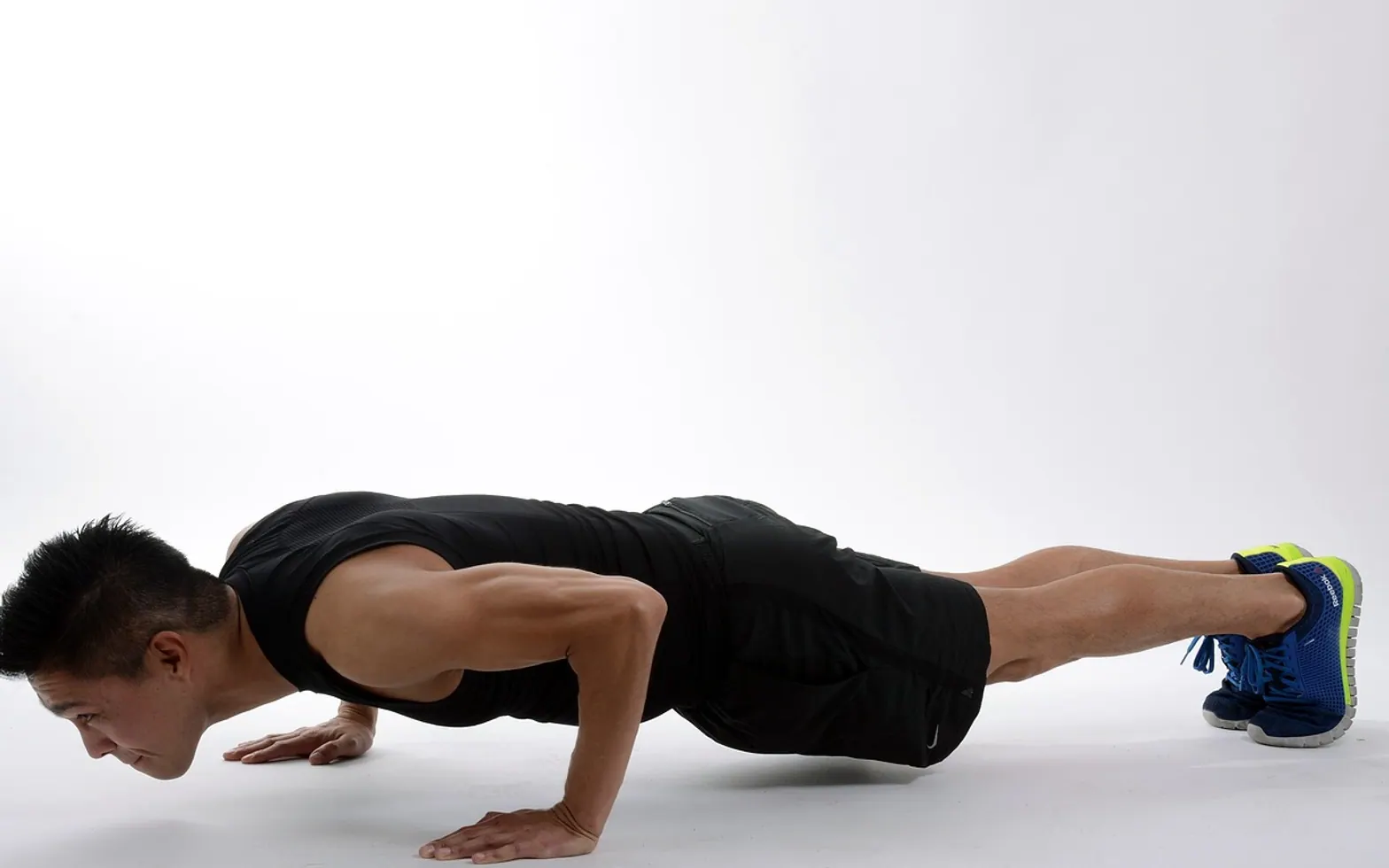
Push-ups mainly work the chest (pectoralis major), the front of the shoulders (anterior deltoids) and the backs of the upper arms (triceps). Muscles around the shoulder blades, especially the serratus anterior, help control the movement, while the abdominals, glutes and thighs hold your body in a straight line like a moving plank. Changing hand position or the angle of your body shifts which of these muscles works hardest.
The muscles a push-up works
| Muscle | Where it is | Its job in the push-up |
|---|---|---|
| Pectoralis major | Chest | Pushes the body away from the floor |
| Anterior deltoid | Front of the shoulder | Assists the chest in the press |
| Triceps brachii | Back of the upper arm | Straightens the elbows |
| Serratus anterior | Side of the ribcage | Moves and steadies the shoulder blades |
| Abdominals and obliques | Front and sides of the trunk | Stop the hips sagging |
| Glutes and quadriceps | Hips and thighs | Keep the body rigid from head to heel |
That mix is why the push-up is such good value: one movement trains the upper body and the trunk together.
How hand position changes the focus
- Standard: hands slightly wider than the shoulders. A balanced mix of chest, shoulders and triceps.
- Wide hands: places more emphasis on the chest. Keep it moderate; very wide positions can strain the shoulders.
- Narrow or close-grip: hands under the shoulders, elbows brushing the ribs. More work for the triceps.
- Feet raised: shifts more load to the upper chest and shoulders and makes the exercise harder.
- Hands raised: on a bench or worktop, reduces the load and suits beginners.
How to do a push-up with good form
- Place your hands on the floor a little wider than your shoulders, fingers spread.
- Step your feet back so your body forms a straight line from head to heels.
- Tighten your stomach and squeeze your glutes to keep your hips level.
- Lower your chest towards the floor, elbows angled back at roughly 45 degrees rather than flaring out to the sides.
- Stop just above the floor, or as low as you can control.
- Press the floor away until your arms are straight, without locking the elbows hard.
Breathe in on the way down and out as you push. Quality matters more than numbers: a few controlled reps beat many sagging ones.
A simple progression, from wall to floor
Most people build push-up strength fastest by choosing a version that allows eight to twelve clean reps and moving on only when it feels easy.
- Wall push-up: hands on a wall at chest height, feet a step or two back.
- Worktop push-up: hands on a sturdy kitchen counter.
- Low incline push-up: hands on a stable bench, step or sofa arm.
- Knee push-up: on the floor, knees down, body straight from head to knees.
- Full push-up: on hands and toes.
- Harder options: slow lowering, a pause at the bottom, close-grip or feet raised.
Common push-up mistakes
- Sagging hips: brace the stomach and squeeze the glutes, or move to a higher incline.
- Hips piked up: lower them until your body forms a straight line.
- Elbows flared wide: tuck them slightly towards your sides.
- Head dropping: look at the floor a little ahead of your hands.
- Half reps: choose an easier version so you can use a fuller range.
How often and how many?
Two or three times a week is a good rhythm, with a day between sessions. Start with two or three sets of whatever version gives you eight to twelve good reps. Push-ups pair well with bodyweight squats and core moves from our beginner ab workout for a short full-body session. If you are planning several training days, our guide to workout splits shows where push-ups fit.
Balance pushing with pulling
Push-ups train the front of the upper body. To keep the shoulders balanced, add exercises for the back as well, such as rows with a resistance band, reverse flys or a “superman” hold lying face down. Many people who sit for long periods benefit from extra upper-back work.
A note on wrists and shoulders
If your wrists ache, try making fists and resting on your knuckles on a soft mat, or use push-up handles or a pair of sturdy dumbbells as grips. Shoulder pain during push-ups is a sign to stop and try an easier incline. If pain persists, a physiotherapist can check what is going on.
Quick answers
Do push-ups work the abs?
Yes. The abdominals work hard to stop your hips sagging, so the push-up doubles as a core exercise.
Do knee push-ups count?
Absolutely. They train the same muscles with less load and are a sensible step towards full push-ups.